
It usually doesn’t start with a crisis.
It starts with a quiet feeling.
A pause you can’t quite explain.
A shift in how your child shows up in the room.
A sense that something feels different — even though nothing dramatic has happened.
For many parents, that feeling begins after screens slowly become part of everyday life.
And it makes sense that you’d start wondering what those hours in front of a phone, tablet, or gaming system might actually be doing inside a developing brain.
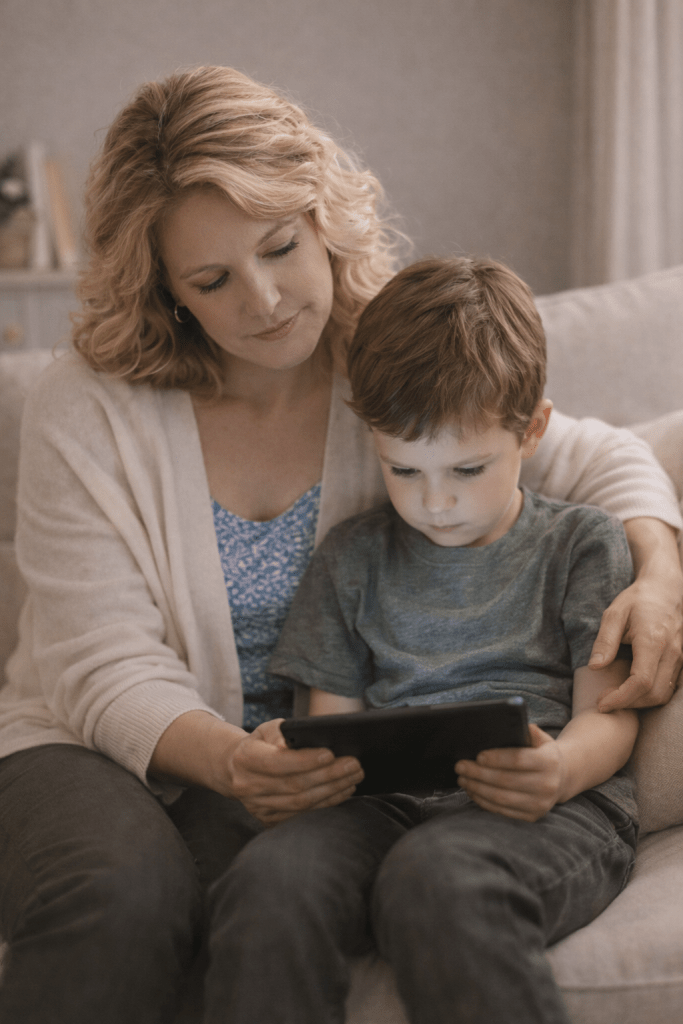
Because a child’s brain is not just growing — it is wiring itself around daily experiences.
Neuroscience tells us that the early and middle childhood years are a period of rapid brain development, especially in the systems that support attention, language, emotional regulation, and self-control.
One large brain-imaging study published in JAMA Pediatrics found that higher screen use in young children was associated with differences in the white-matter pathways that support language and executive functioning — skills that help children focus, plan, and regulate behavior (Hutton et al., 2019, JAMA Pediatrics).
This doesn’t mean screens are “damaging” your child.
But it does suggest that screens may shape the developing brain differently than real-world interaction, conversation, movement, and play.

As children grow older, similar patterns continue to appear.
A large longitudinal study following more than 4,000 children found that higher amounts of screen time at ages 9–10 predicted increases in attention-related difficulties two years later — along with differences in brain development in regions linked to cognitive control (Cheng et al., 2024).
In other words, the brain systems that help a child stay present, manage impulses, and shift attention appear to be sensitive to how much time is spent in digital environments.
You may notice this not as a diagnosis — but as a change in everyday life.
- Less patience
- Less Flexibility
- More emotional reactivity
- More difficulty pulling away
Research with infants and preschool-aged children also shows that higher screen exposure is associated with lower language and cognitive scores later in development (Madigan et al., 2020, JAMA Pediatrics).
And studies of young children’s social development show that heavy screen use — especially when it replaces shared attention with caregivers — is linked to lower levels of joint attention and social engagement (Zhang et al., 2025, Scientific Reports).
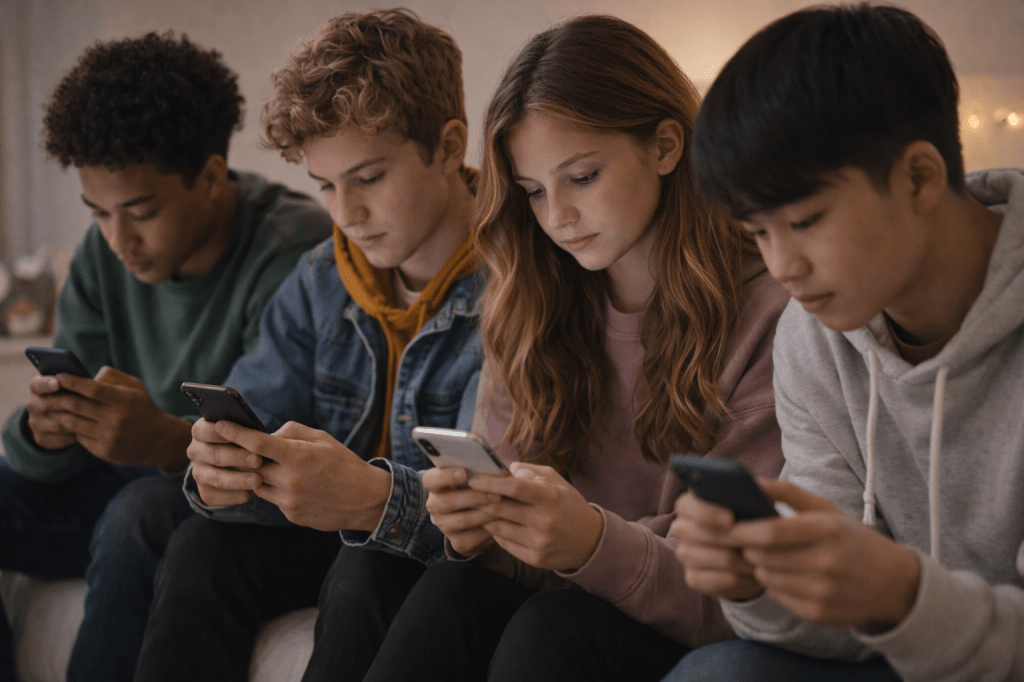
What matters most here is not fear.
It’s understanding.
Researchers consistently emphasize that screens are not inherently harmful — but that they often displace the very experiences the developing brain needs most:
- Conversation
- Shared attention
- Physical play
- Emotional co-regulation
- Boredom
- Creativity
- Connection
- (American Academy of Pediatrics, 2016; reaffirmed guidance)
When screens quietly take the place of those moments, the brain adapts — because the brain always adapts to the environment it is given.
This is why so many parents begin to notice subtle changes long before they see obvious problems.
You may notice:
- your child staying in their room more
- conversation becoming shorter
- frusration rising more quickly
- emotional connection feeling harder to access
Not because you did anything wrong.
But because the environment around your child has shifted — and their brain is responding to that shift in real time.
Importantly, researchers are also very clear about something else:
Screens alone do not determine a child’s outcomes.
Family relationships, sleep, stress, physical activity, mental health, school environment, and emotional safety all play powerful roles in development (Domingues-Montanari, 2017, Frontiers in Psychology).
This is not about perfection.
It is about awareness.
Beginning to question screens is not about taking something away.
It is about noticing what your child’s brain might be asking for more of:
- more connection
- more presence
- more space to be a child
- more time in the real world – with you
If you are starting to wonder about screens in your home, you are not late.
You are paying attention.
And that is where meaningful change actually begins.
Book a free 30 – minute consultation
 Purpose with Parenting